For years, medical billing followed a straightforward process. A provider delivered a service, documented it, submitted the appropriate code, and received payment based on that service.
Today, healthcare is moving toward a different approach.
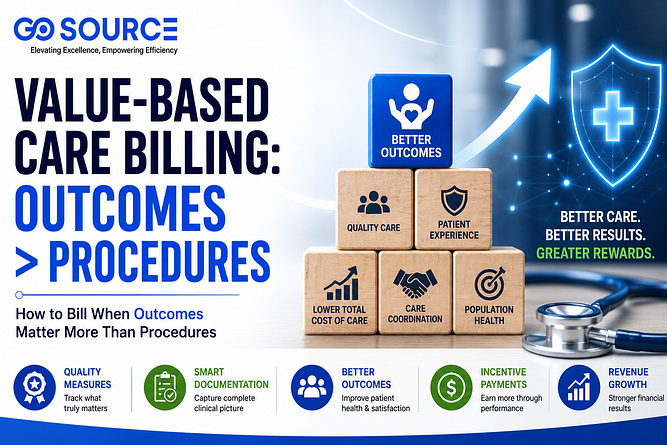
Instead of focusing solely on the services provided, many reimbursement models now consider patient outcomes, quality of care, chronic disease management, and overall healthcare costs. In other words, providers are increasingly being rewarded not just for what they do but for how effectively they help patients achieve better health outcomes.
This shift toward value-based care is transforming the way practices approach billing and revenue cycle management. Quality measures, care coordination activities, risk adjustment coding, and patient outcomes are becoming just as important as procedure codes when it comes to reimbursement.
The challenge is that many billing processes were originally designed for traditional fee-for-service models. They excel at capturing procedures and submitting claims but often fail to track the additional documentation and performance data required under value-based contracts.
As a result, some practices are delivering high-quality care without receiving the full reimbursement they have earned.
In this guide, we’ll explain what value-based care billing involves, how it differs from traditional billing, and what practices need to do to succeed as reimbursement continues to shift toward outcomes-based models.
See how modern billing changes are already affecting speciality practices — Read More here.
What Is Value-Based Care Billing?
Value-based care is not a single payment model. Instead, it refers to several reimbursement approaches that tie payments to quality, efficiency, and patient outcomes rather than simply the volume of services provided.
Some of the most common value-based payment models include:
Shared Savings Programs
Programmes such as Accountable Care Organisations (ACOs) reward providers for delivering high-quality care while reducing overall healthcare costs. Practices may share in the savings when spending remains below established benchmarks and quality goals are achieved.
Bundled Payments
Under bundled payment arrangements, providers receive a single payment for an entire episode of care, such as a joint replacement, maternity care, or a cardiac procedure. Success depends on managing costs while maintaining quality throughout the patient’s care journey.
Quality Incentive Programs
Programmes like MIPS adjust reimbursement based on performance across several categories, including quality measures, cost management, improvement activities, and interoperability. Strong performance can lead to incentive payments, while poor performance may reduce reimbursement.
Capitation Models
In a capitated arrangement, providers receive a fixed payment per patient each month regardless of how many services are delivered. Financial success depends on managing patient populations effectively and preventing avoidable healthcare costs.
Although these models differ, they all have one thing in common: reimbursement depends on more than submitting a claim.
Clinical documentation, quality measure reporting, risk adjustment coding, care coordination efforts, and patient outcomes all play a role in determining how much a practice ultimately gets paid. That means billing teams must work closely with clinical staff to ensure the information needed for value-based reimbursement is captured accurately and consistently.
What Actually Changes in Your Billing Workflow
Quality Measure Documentation Becomes Part of Billing
In a traditional fee-for-service model, documentation mainly exists to support the services billed. In value-based care, documentation has a much bigger role. It must also capture the quality measures that impact reimbursement.
Questions like these now matter:
- Was the patient’s HbA1c tested this quarter?
- Is their blood pressure under control?
- Was a depression screening completed?
- Was preventive care discussed?
- Was tobacco cessation counselling provided?
These quality measures don’t automatically appear just because a visit was documented. They need to be recorded properly within structured EHR fields so they can be included in quality reporting.
When these details are missed, practices may appear to be underperforming even when they are providing excellent care. The result is lower quality scores and missed incentive payments that could have been earned.
Chronic Condition Coding Drives Risk Adjustment Revenue
For practices participating in Medicare Advantage, ACOs, and other risk-based programmes, accurate chronic condition coding is essential.
It’s no longer enough to document chronic conditions only during annual visits. Conditions such as diabetes, hypertension, heart failure, COPD, and chronic kidney disease should be documented whenever they are actively assessed or managed during a patient encounter.
For example, if a patient with diabetes, hypertension, and heart failure comes in for a routine follow-up, all relevant conditions should be addressed and coded when appropriate.
This process is known as Hierarchical Condition Category (HCC) coding. Consistent HCC documentation helps accurately reflect patient complexity, supports risk adjustment, and ensures practices receive the reimbursement they are entitled to.
Practices that document chronic conditions consistently throughout the year often achieve stronger risk-adjusted payments than those that only update diagnoses during annual wellness visits, even when both are caring for similar patient populations.
Care Coordination Activities Can Generate Additional Revenue
One of the biggest changes in value-based care is the increased focus on care coordination. Many of the activities that help improve patient outcomes are not only important for quality care but can also be billed separately when documented correctly.
This includes tasks such as:
- Following up with patients after hospital discharge
- Reviewing lab results and communicating next steps
- Updating care plans
- Coordinating with specialists
- Reaching out to patients who miss appointments
- Managing ongoing chronic conditions between visits
Several CPT codes are designed specifically for these services. For example, Chronic Care Management (CCM) codes (99490, 99491) cover monthly care management for patients with multiple chronic conditions. Principal Care Management (PCM) codes (99424–99427) support the management of a single complex condition, while Transitional Care Management (TCM) codes (99495, 99496) cover care coordination after a hospital stay.
The reality is that many practices already perform these services every day but fail to document or bill for them consistently. As a result, valuable revenue opportunities are often left on the table.
Patient Engagement and Preventive Care Matter More Than Ever
Value-based contracts don’t just measure treatments and procedures. They also evaluate how effectively practices engage patients and promote preventive care.
Activities such as discussing healthy lifestyle habits, providing smoking cessation support, reviewing medication adherence, offering preventive screenings, or referring patients to disease management programmes can all contribute to quality performance scores.
Examples include:
- Diet and exercise counseling
- Diabetes education referrals
- Smoking cessation support
- Preventive screening discussions
- Advance care planning conversations
- Medication adherence counseling
To receive credit for these efforts, they must be clearly documented in the patient’s record. If these interactions are not recorded, they often don’t count toward quality measures, regardless of whether the conversation actually occurred.
In value-based care, strong documentation doesn’t just support compliance — it helps ensure your practice receives appropriate reimbursement for the work already being done to improve patient outcomes.
The Documentation Gaps Costing Value-Based Practices the Most
Chronic Conditions Documented Once and Never Revisited
One of the most common mistakes in value-based care is treating chronic condition documentation as a once-a-year task. A patient’s diabetes, hypertension, or heart failure may be documented during an annual visit, but if those conditions are not addressed and documented throughout the year, valuable risk adjustment opportunities can be missed.
For HCC coding and risk-adjusted reimbursement, chronic conditions need to be documented whenever they are actively assessed, monitored, evaluated, or managed. When they are left out of subsequent encounter notes, the patient’s true complexity may not be reflected, which can lead to lower reimbursement despite providing the same level of care.
Quality Measures Completed but Not Properly Recorded
Many practices perform the right clinical actions but fail to receive credit for them because they are not documented in the correct place.
For example, a provider may discuss colorectal cancer screening, blood pressure management, or preventive care recommendations during a visit. However, if those activities are only mentioned in free-text notes and not entered into the structured fields used for quality reporting, the measures may not count toward performance scores.
As a result, quality ratings can suffer even when patient care meets all the required standards.
Care Coordination Time Going Untracked
Care coordination plays a major role in value-based care, but it is often one of the most under-documented activities in a practice.
A care coordinator may spend significant time reviewing medications, coordinating specialist referrals, following up with patients, or updating care plans. If that time is not properly tracked and documented according to billing requirements, services such as Chronic Care Management (CCM) cannot be billed.
The work is being done. The reimbursement simply isn’t being captured.
Wellness Visits Billed Incorrectly
Annual wellness visits for Medicare patients are different from standard office visits and come with their own documentation requirements.
These visits must include elements such as health risk assessments, preventive care planning, and other required components. When practices use a standard office visit template instead of a wellness visit workflow, they may miss the opportunity to bill the appropriate wellness visit codes and receive credit for preventive care measures.
Over time, these documentation gaps can reduce both reimbursement and quality performance scores, making them one of the most costly issues for practices participating in value-based care programs.
How to Fix Your Billing for Value-Based Care
Start With Your Quality Measures
Every value-based care contract comes with a specific set of quality measures that directly impact reimbursement. The first step is making sure your clinical and billing teams understand exactly what those measures are.
Keep the measure list easily accessible and build documentation prompts into your EHR templates. When quality measures are built into everyday workflows, they are captured consistently instead of relying on memory or manual follow-up.
Make HCC Documentation Part of Every Visit
Accurate risk adjustment depends on consistent documentation of chronic conditions throughout the year.
Instead of documenting conditions only during annual visits, create a dedicated section within your encounter templates that prompts providers to review and document active chronic conditions whenever they are assessed or managed.
This helps ensure patient complexity is accurately reflected and supports appropriate risk-adjusted reimbursement.
Create a Care Management Billing Workflow
Many practices are already providing care management services but aren’t billing for them consistently.
Identify patients who qualify for programmes such as Chronic Care Management (CCM), particularly those with multiple chronic conditions who require ongoing support. Then establish a clear process for:
- Tracking care management time
- Documenting patient interactions
- Assigning responsibility for claim submission
- Monitoring reimbursement
When managed correctly, care management programmes can create a meaningful revenue stream while improving patient outcomes.
Review Quality Performance Every Month
Don’t wait until the end of the year to discover documentation gaps.
Review quality measure reports monthly and compare them against your patient population. For example, if diabetic patients appear to have low HbA1c screening rates but providers are regularly ordering the tests, the issue may be documentation rather than clinical performance.
Regular audits help identify missing data, improve reporting accuracy, and ensure your practice receives full credit for the care it is already providing.
The most successful value-based care organisations don’t simply deliver quality care — they build workflows that capture, document, and report that care consistently. When documentation, coding, and billing are aligned, practices can maximise both quality performance and reimbursement.
The Takeaway
Value-based care billing isn’t necessarily more difficult than traditional fee-for-service billing. The difference is that reimbursement depends on more than just the services provided. It also depends on how well your practice documents quality measures, chronic condition management, care coordination efforts, and patient outcomes.
Practices that have adapted their billing workflows to support value-based care are seeing the benefits. They are accurately capturing quality metrics, documenting chronic conditions consistently, billing for care management services, and maximising the incentive payments tied to their contracts.
On the other hand, practices that continue using fee-for-service documentation habits often miss opportunities for additional reimbursement. The care is being delivered, but the supporting documentation and reporting may not be capturing its full value. Unlike traditional claim denials, these missed opportunities often go unnoticed because there is no rejection notice or obvious warning sign.
Success in value-based care requires more than accurate coding. It requires a coordinated approach that aligns clinical documentation, quality reporting, risk adjustment, and billing processes.
GoSourceMD helps practices navigate value-based care by supporting quality measure reporting, HCC coding, care coordination billing, and documentation workflows that ensure providers receive appropriate reimbursement for the care they deliver every day.
FAQs
Q. Do I need to change my entire billing system to support value-based care?
Not necessarily. Most practices can work with their existing billing systems. The bigger changes usually involve updating clinical documentation workflows, adding structured fields for quality measures within the EHR, and creating a process to track care coordination activities. While your billing platform may remain the same, the way information is documented and reported often needs to evolve to support value-based reimbursement.
Q. What is the difference between MIPS and shared savings programs?
Both are value-based payment models, but they work differently.
- MIPS (Merit-Based Incentive Payment System) adjusts Medicare reimbursement based on performance in areas such as quality, cost, improvement activities, and interoperability.
- Shared Savings Programs reward providers for lowering the overall cost of care while maintaining quality standards. If a practice helps reduce healthcare spending below a predetermined benchmark, it may receive a portion of those savings.
Both models rely heavily on accurate documentation and quality reporting, but shared savings programmes place additional emphasis on managing the total cost of care across a patient population.
Q. How much revenue could a practice be missing by not billing Chronic Care Management (CCM) services?
The impact can be substantial. Many practices already provide ongoing support to patients with multiple chronic conditions through phone calls, medication reviews, care planning, and follow-up coordination. If those activities are not documented and billed correctly, the associated reimbursement is lost.
For practices with a large population of eligible chronic care patients, the missed revenue can add up quickly over the course of a year. More importantly, it represents reimbursement for work that is already being performed but not captured through the billing process.
Q. Can I bill fee-for-service and value-based care services at the same time?
Yes. In most cases, value-based care programmes are designed to complement traditional fee-for-service billing rather than replace it.
Practices continue billing standard E/M services, procedures, and other covered services as usual. Value-based reimbursement is layered on top through quality incentives, care management services, risk adjustment programmes, and performance-based payments.
The key is ensuring that documentation supports both the traditional claim and the additional reporting requirements tied to value-based contracts.